Monday, 24 February 2014

Teach them well...


Our visit to CERN proper started in a crowded lecture room.  As well as the 51 UK teachers, there were around 40 Israeli students and their teachers.  Israel has just become a full member state of CERN, and these students were the first visitors since that event.  Over the three days, it was fascinating to watch these young people sit through some fairly tricky lectures on cosmology, the Higgs Boson and medical applications of particle physics amongst others.  And not only did they sit through the lectures, they listened and asked intelligent questions at the end.

Each year CERN hosts tens of thousands of visitors.  Amongst these are teachers from all the member states of CERN, as well as other friendly states.  The teacher programmes typically last a week (our UK programme is a little shorter than most), and is hosted where possible by a researcher from the visiting teacher’s home country. 

The education and visits programme is a massive endeavour for CERN, and so it is reasonable to ask ‘Why?’.  What is the benefit to CERN of inviting teachers and others to wander round the facilities, taking photos, getting in the way and filling the restaurant?

Indeed, one could also ask why the National Science Learning Centre, and STFC (who provide financial support for our study visits) take teachers to CERN.

The answer, said in a slightly misty eyed way way, is that it is for the kids.  We, in the words of a song, believe that children are our future.  
The future?

More prosaically, without kids taking STEM subjects, there won’t be big science and technology undertakings in the future.  Somewhere like CERN is the work of a LOT of people – people who studied sciences, engineering, architecture, and other STEM subjects.  And at some point, those people were in all likelihood taught science by enthusiastic teachers who made them think that science was a subject worth studying.

So CERN (and NSLC) want to work with the teachers because they are the multipliers.  If a single student, such as one of our Israeli companions, comes to CERN then that is one person who will (in all probability) be enthused about science.  However, if one teacher comes, then that teacher will go back into school or college with a renewed interest and, dare I say it, excitement about science.  One teacher may teach 200 to 300 students each year.  As the teacher says ‘when I was in CERN….’ and shares the excitement of standing just in front of a 15m wide particle detector 100m below the French countryside, then their interest can be contagious and spread to some of their students.  So one person’s visit will hopefully inspires classrooms full of students.
Up close and personal with a beam pipe
And it’s not just seeing the scale of the undertaking.  The guides who show the teachers round are often researchers, who volunteer to show people round CERN.  Meeting the researchers, chatting to them and asking about how they ended up working in CERN, provides real examples to teachers of possible career paths that their own students might take.  Career paths which the (non-specialist) science teacher might not have realised were possible.
Konrad, explaining why there is more than one particle accelerator at CERN
So to CERN, the cost and disruption, of hosting teacher programmes is worth it.  In fact, it is part of their core mission to the future.

Tuesday, 18 February 2014

Arriving at CERN


First impressions


I think that the main thing that struck me about CERN is its apparent normality.  Walking around the site on a Sunday afternoon, above ground, CERN looks very like the light industrial estates that surround my home town.  Large non-descript buildings, empty roads and cul-de-sacs.
Industrial estate?
There are some hints to let you know that it isn’t just an industrial estate: the roads are named after famous physicists; the French-Swiss border passes, unmarked, across a roundabout; and there are a lot of compressed gas cylinders (often Helium) outside the buildings.   

Sounds familiar.


I'm standing in Switzerland, the trees are in France.

For party balloons or particle accelerators?


Another noticeable feature is the noise.  Even on a Sunday afternoon there is a constant hum in the air coming from some of the buildings.  It sounds very like the hum of an air conditioning unit.  In a country where almost everything is shut on a Sunday, the equipment at CERN keeps running.

Sitting in the restaurant (thankfully also open on a Sunday) snippets of conversation float through the air, different languages, different accents.  Mostly everyday topics, but every now and then physics appears.  

CERN Restaurant 1 - one of the most cosmopolitan places to eat anywhere.

Of course, the really interesting thing about CERN is not what happens above ground.  It is in the tunnel underground that makes CERN special.  And it is the experiments at CERN that I, and 51 teachers from the UK, are looking forward to finding out about.
The participants on the Feb 2014 CERN study trip

Wednesday, 1 January 2014

The first 20 hours.

I have recently read the book 'The first 20 hours' by Josh Kaufman. He also gave a talk at the RSA (as authors do when they have a book to sell) and you can find the podcast here.

Malcolm Gladwell popularised the idea that it takes 10000 hours to become a leading expert at something.  However, this premise has been challenged by a number of people such as Fiona McQuarrie.  Perhaps, as with many things, it's more complicated than first proposed.

Which brings me to Kaufman's premise.  The basic idea of Kaufman's book is that, although it might take a long time to become an expert, you can get 'good enough' at any activity in 20 hours. He identifies ten principles of rapid skill aquisition:
  1. Choose a lovable project
  2. Focus your energy on one skill at a time
  3. Define your target performance level
  4. Deconstruct the skill into subsets
  5. Obtain critical tools
  6. Eliminate barriers to practice
  7. Make dedicated time for practice
  8. Create fast feedback loops
  9. Practice by the clock in short bursts
  10. Emphasise quantity and speed
He then talks through these principles, and also talks about the features of effective learning.  The bulk of the book is made up of case studies about six different activities that Kaufman undertook and used these principles on.  They cover physical skills (windsurfing, yoga and touch typing) to more academic skills (programming, playing Go and playing the ukelele)

I enjoyed the book, although to be honest I think that you can get the essential theme of the book from the podcast.  It was worth reading as an educator when thinking about how to structure learning so as to help students to gain initial mastery in a topic/subject

Certainly in my own experience, Kaufman's principles hold true.
 
Getting hooked
Just over a year ago I decided to learn how to crochet. I was looking for something to do on the train that wasn't just tweeting or playing games.  Crochet was a craft that I haven't tried before, and I thought that it would probably be more portable than knitting or sewing.  So I asked twitter for recommendations of teach yourself books, bought 'Crochet Unravelled' by Claire Bojczuk, and started to learn.  My first few hours were spent crocheting test samples and then unravelling them and then re-crocheting them.  I wasn't really bothered about making anything particularly, I just wanted to get the technique right.
 
Once I had got the hang of a few basic stitches, I started to attempt flowers and circle shapes.  Initially, these tended to be a little more 3D than I intended.
3D flower

A flatter flower
When I was in hospital for an overnight operation, I had the ideal opportunity to spend a concentrated period of time crocheting and managed to complete a hat for my daughter (hence the pink).
 
A very pink hat.


So within the 20 hours suggested by Kaufman, I was able to learn the basics of crocheting and create a reasonable product.

What significance does 20 hours have for school?
It is easy to see where the principles as outlined by Kaufman could be applied in skills based subjects (such as the crochet described above).  It is perhaps less clear how applicable this might be to more 'knowledge based' topics (and this is a question that Kaufman doesn't really address in the RSA talk).  Certainly in a school it might be hard always for students to choose a loveable project (i.e. one that they are personally very interested in).  
 
However, many of the principles are aligned with the ideas of formative assessment - identifying success criteria, deconstructing skills into subsets, and creating fast feedback loops.

Certainly, the fact that I can now quote the possibility of gaining 'good enough' skills is more motivating to my kids.  A common lament when discussing the 10000 hours rule is that they didn't want to be concert pianists - just better at playing the piano.  So the idea that we can now identify a particular skill and they can improve that in just 20 hours is more helpful.

Monday, 30 December 2013

A look back and a glance ahead.


So, what has 2013 brought, and what does 2014 hold?

On a mundane level, as has been the case for the past two years, in 2013 I've spent a lot of time on trains commuting to and from York and travelling around the country for various (often exam board) meetings.  I've improved my crochet skills, watched a lot of Pointless on my tablet, and earned enough loyalty points to swop for 24 bottles of wine!

As an educator who has left the classroom, I have regularly been asked if I would ‘go back’.  My stock answer is that I started out teaching adults in an FE college, and have now come full circle again.  I am still teaching, just not in any single school.  This year has, once again emphasised how much I enjoy working with teachers, both those who come onto our residential courses at NSLC and also those who are in schools that I’m involved in.

One of the areas that I’ve really delved into more this year has been education research and education policy.  The connectedness of twitter meant that I was able to be part of @tombennett71 (and not forgetting his fabulous deputy-in-arms @Hgaldinoshea) ResearchEd2013 conference, and also to get involved (in a very small way) with @HeadsRoundtable.  Both have given hope about education.  The ResearchEd conference showed how enthusiastic some teachers are about improving their teaching.  HTRT introduced me to some great head teachers who are working towards improving the life-chances of students in their schools in quite different circumstances, as well as who are speaking out about their beliefs.  Getting to know @RosMcM has been a particular pleasure.

On the policy front, it feels like I’ve been completing consultation forms constantly both for myself, and as part of various organisations I'm involved with. Not forgetting the latest two from Ofqual on A-levels and GCSEs, which close on 17th and 31st January.

I’ve also enjoyed reading blogs this year (though it’s hard to keep up with them all).  I particularly enjoy @johntomsett’s and @tombennett71 for the quality of their writing.  One of my ambitions is to write books – probably text books – and reading these two blogs in particular challenge my writing significantly.  Writing my own blog, and also writing blogs for work (such as on embedding the impact of CPD and this on science investigations), has (slowly) helped me to work on my writing.  Writing mainly about science subject specific topics mean that I don’t necessarily get as many views as some of the more general blogs (not that I’m counting, of course), but hopefully some of the ideas find their way into science lessons and that is always good to know.  I was also able to publish a paper, about the ASE summer conference session that I coordinated, in the SSR journal.

This year has also taught me, both personally and in the wider educational world, that times of change are hard.  It has proved important for me to look at what it is I’m good at, what is important, and keep doing those things.  This is also the ethos that I recommend to teachers on the courses.  As educators we are buffeted on all sides and if we are to do the best for those we teach we need to focus on the things that are important.  With the increase in accountability and measurement that teachers and students are subject to this is becoming increasingly difficult, particularly for classroom teachers.

Next year
Well, I’m trying not to look at my diary too much.  It’s already pretty full up until August, and I’ve said ‘yes’ to a number of freelance projects which need to be squeezed in before then somewhere.  I may be able to write more about those as, and when, details are firmed up.

I’m looking forward to seeing how the Stimulating Physics Network project develops as the tender renews in April.  Hopefully the IOP will be able to develop this further, but we’ll have to see what the outcome of the tendering process before I know how I’ll be affected by any changes.

With NSLC I’m taking a group of 50 science teachers on a study visit to CERN, a slightly daunting, but very exciting prospect.  I shall be counting heads madly to make sure I don’t leave anyone behind!  Also at work, a number of my colleagues are moving on to pastures new in the next few months and will be sorely missed.  

I’m also looking forward to meeting more twitter folk at various tweet-ups, conferences and courses (if you’re in York at NSLC, do say hello).  One of the really good things about twitter is the opportunity to meet lovely people who would otherwise have passed me by.

In a song, John Lennon says 'Life is what happens to you when you're busy making other plans'.  So this year I'm trying to avoid making the other plans, and will just get on with experiencing life as it happens.

Thursday, 19 December 2013

An Apple A Day...


Research has once again shown the benefit of eating fruit or vegetable.  Yesterday the news media was full of headlines like this:


http://www.bbc.co.uk/news/health-25413939

“Fabulous” I thought.  “I wonder where this research came from?”   

So I decided to follow the research back to its origins - a fairly straightforward task.  It turns out that the research was published in the British Medical Journal’s Christmas edition – a traditionally light-hearted edition often with slightly less-than-serious research articles.

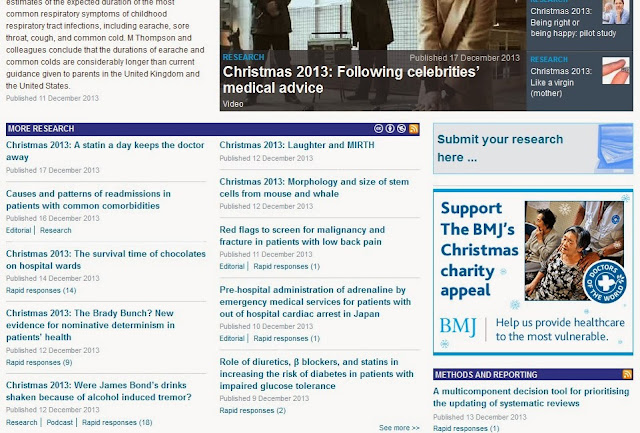
For example, here is a selection of the titles of other articles in the Christmas 2013 edition:
http://www.bmj.com/uk/research


The good news is that many of the articles are open access so you could download them and use them with students to show what a research paper looks like and how they are structured.  The light-hearted topics means that they are more ‘accessible’ than traditional research papers, but are still structured in the same way.  It could also be used to look at how computer modelling is used to look at the potential effectiveness of medical interventions without actually carrying out the intervention.


If you want to do that then the link to the apple story is here.


I heard/read a number of comments about the value of prescribing an apple instead of statins, such as this tweet:

I wondered about the cost-effectiveness of prescribing an apple a day to the population over 50 (around 21 million people according to this source).  Pleasingly, the authors of the paper actually calculate the cost of prescribing statins (to everyone over 50 who isn’t already taking them for other medical reasons) and the cost of prescribing apples.

Cost of additional Statins: £180 million
Cost of apples: £260 million

So, if the NHS were to prescribe apple, which I envisage to be a little like fruit time in primary school, it would cost more than £80 million MORE than prescribing statins.  

Of course, the statins have additional side effects which would have to be taken into account.  The authors also assumed that calorie intake would remain the same if everyone ate an apple, but that might not be the case, so the side effects from that should also be considered.

Interesting questions to ask:

  • Why might people be happy to pay for an ‘apple a day’, but not a ‘statin’ a day?
  • Could/Should the NHS prescribe fruit&vegetables in the same way that they prescribe medications?
  • The authors assume a 70% compliance rate in eating the apple – is this realistic?
  •   Should researchers spend time writing light-hearted research articles?
  • Why did the news media pick up on the story, and report it without comment on the reasons why it was written?
 Enjoy, and do let me know if you use this in class.